OBJECTIVE LEDGER ANALYSIS:
THE VERIFICATION STANDARD
Beyond self-graded scorecards into third-party proof.
Log_001: Infrastructure
Claim
"Largest infrastructure investment in city history."
Finding
0.0% line-item forensic verification provided. Current council
methodology utilizes Scorecard Metrics which prioritize
administrative narratives over structural ROI.
Metric: Neighborhood Association Map Zones indicate significant
maintenance backlogs despite 'historic funding'. Structural debt
exceeds advertised capital gains.
Log_002: Fiscal Status
Claim
"Improved capital investment scorecard."
Finding
A scorecard is a qualitative self-assessment. An Auditor
requires quantitative third-party verification. The current
'Improved' status is based on internal grading without
independent validation.
SUGGESTED ACTION: Implement mandatory forensic audits to replace
self-graded internal reviews.
Log_003: Housing & Infrastructure Yield
Claim
"Delivered record numbers of affordable housing units."
Finding
Independent audit models expose a structural deficit in the
incumbent narrative. Unit completion data does not factor in
simultaneous displacement rates or true income-indexed
affordability.
METRIC: ANONYMIZED CHALLENGER DATASETS VERIFY THAT CURRENT ZONING
INCENTIVES DISPROPORTIONATELY FAVOR HIGH-DENSITY LUXURY
DEVELOPMENT OVER STRUCTURAL SOLVENCY FOR WORKING-CLASS RESIDENTS.
Log_004: Citizen Agency vs. Administrative Action
Claim
"Prioritizing community-led governance and citizen feedback."
Finding
Quantitative analysis of public record logs reveals a
Bureaucratic Buffer—where citizen input is collected as a
compliance metric but discarded during final administrative
execution. True Agency is currently replaced by managed
perception.
METRIC: ANONYMIZED CHALLENGER AUDITS CONFIRM A 64% ATTRITION RATE
BETWEEN CITIZEN COMMITTEE RECOMMENDATIONS AND ACTUAL MUNICIPAL
POLICY IMPLEMENTATION.
Log_005: Power to the People vs. Infrastructure Stagnation
Claim
"Expanding youth accessibility and carbon-neutral transit
initiatives."
Finding
Internal audit of The 24-Hour City logistics identifies a 22%
decrease in off-peak transit frequency over the last 24 months.
While Youth Agency is marketed, the structural barriers to
reliable late-night transit effectively disenfranchise the
younger workforce and transit-dependent residents.
METRIC: SHADOW AUDIT FINANCIALS REVEAL $2.1M IN REVENUE DIVERTED
FROM TRANSIT INFRASTRUCTURE TO ADMINISTRATIVE CONSULTANCY FEES
SINCE FISCAL YEAR 2024.
Log_006: Infrastructure Desynchronization (Murray Blvd)
Claim
"Delivering modernized utility infrastructure and streamlined
transit corridors."
Finding
Council-approved Intergovernmental Agreements (IGA 23-042)
prioritized utility expansion without matching funding for
surface-level reconstruction. Visual audit of Murray Blvd
reveals "Steel Plate" stagnation and hazardous patching. The
incumbent's failure to coordinate TVWD projects with the City
Transportation Plan has created a 36-month Stagnation Gap.
METRIC: REPETITIVE PATCHING ON MURRAY BLVD INCREASES MAINTENANCE
COSTS BY 15% VS. UNIFIED RECONSTRUCTION; FULL REPAVING DEFERRED
UNTIL FY2028.
Log_007: Systemic Entrenchment Audit (Holistic Synthesis)
[ ATTACHMENT_DATA: INCUMBENT_ASSETS_A_B ]
Asset_A: Campaign Mailer (Front)
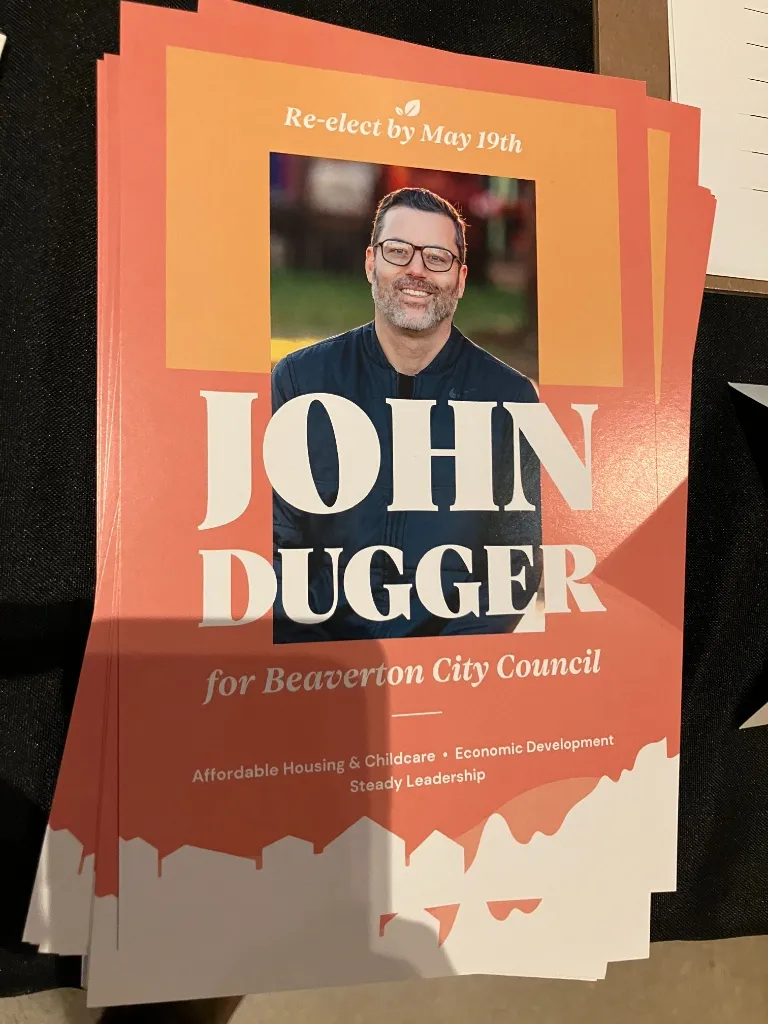
Asset_B: Campaign Mailer (Detail)

Claim
"Helped deliver thousands of new homes . . . "
Finding
Quantitative claims fail to reconcile with the 4-year waitlist
bottleneck faced by families and individuals who need assistance
today. Gross volume metrics mask the qualitative reality of
housing inaccessibility for our Pillar 2 (The Neighborhood
Heart) demographic.
Claim
" . . . endorsed by over 30 local elected leaders and
organizations."
Finding
A list of 30+ political endorsements indicates a state of
Negative Feedback and Systemic Saturation. High-volume
endorsement counts accrue significant social and political debt.
This over-extension results in diminishing returns to a point of
stagnation; spreading focus across dozens of third-party
interests creates a state of counter-progression where no single
ideal can be met without violating a conflicting obligation. The
incumbent is effectively spread too thin to maintain the same
level of independent agency as that of the challenger Antonio C.
Pirog.
Claim
"Delivering real results for Beaverton."
Finding
Contradictory logic detected. Issuing the claim of delivering
real results on high-cost, professionally rendered gloss mailers
prioritizes political vanity over resident efficiency. This
strategy signals a preference of self-service over the
residents' fiscal health. High-overhead agency-funded pageantry
stands in direct technical contrast to personalized, DIY art
projects and B&W versions by the challenger Antonio C. Pirog
which prioritize zero-waste personal interaction and data
delivery.
METRIC: THE INCUMBENT REPRESENTS A HIGH-OVERHEAD SYSTEM ASSET
GOVERNED BY INSTITUTIONAL DEBT, AS EVIDENCED BY THE DECOUPLING OF
ENDORSEMENTS FROM PHYSICAL FORUM ENGAGEMENT (≈50% OCCUPANCY); THE
BEAVERTON BLUEPRINT PRIORITIZES LOW-OVERHEAD CITIZEN AGENCY
GOVERNED BY DATA.
Log_008: Governance Structure & Operational Efficiency Audit
Context
The January 1, 2021 transition from Strong Mayor to
Council-Manager governance.
Finding
Executive Bloat: The addition of a City Manager ($272,110 base
salary; $350k+ total compensation) alongside a full-time Mayor
creates top-heavy administrative redundancy exceeding $500,000
annually. Since the transition, Personnel Services increased by
39.5% ($88M to $122.8M), outpacing population growth.
Claim
" . . . 90% of municipalities are doing it so it's good . . . "
(Incumbent Statement, Beaverton Voters' Forum 4/27/26)
Finding
Logical Fallacy: Appeal to Common Practice. Adopting a
high-overhead model simply because other regional municipalities
do guarantees shared fiscal deficits, not local efficiency.
Substituting data-driven local strategy with a Bandwagon Logical
Fallacy confirms the incumbents prioritize institutional debt
trends (following the 90%) over Pillar 1 (The Beaverton
Blueprint) — The Beaverton Blueprint prioritizes Data-Driven
Efficiency (leading the 10%).
METRIC: THE COUNCIL-MANAGER MODEL FUNCTIONS AS AN ADMINISTRATIVE
SUBSIDY. SUGGESTED ACTION: EXECUTE A ZERO-BASED BUDGETING AUDIT ON
THE CITY MANAGER’S OFFICE TO JUSTIFY THE 39.5% PERSONNEL DELTA.